Framework · 2026 Edition
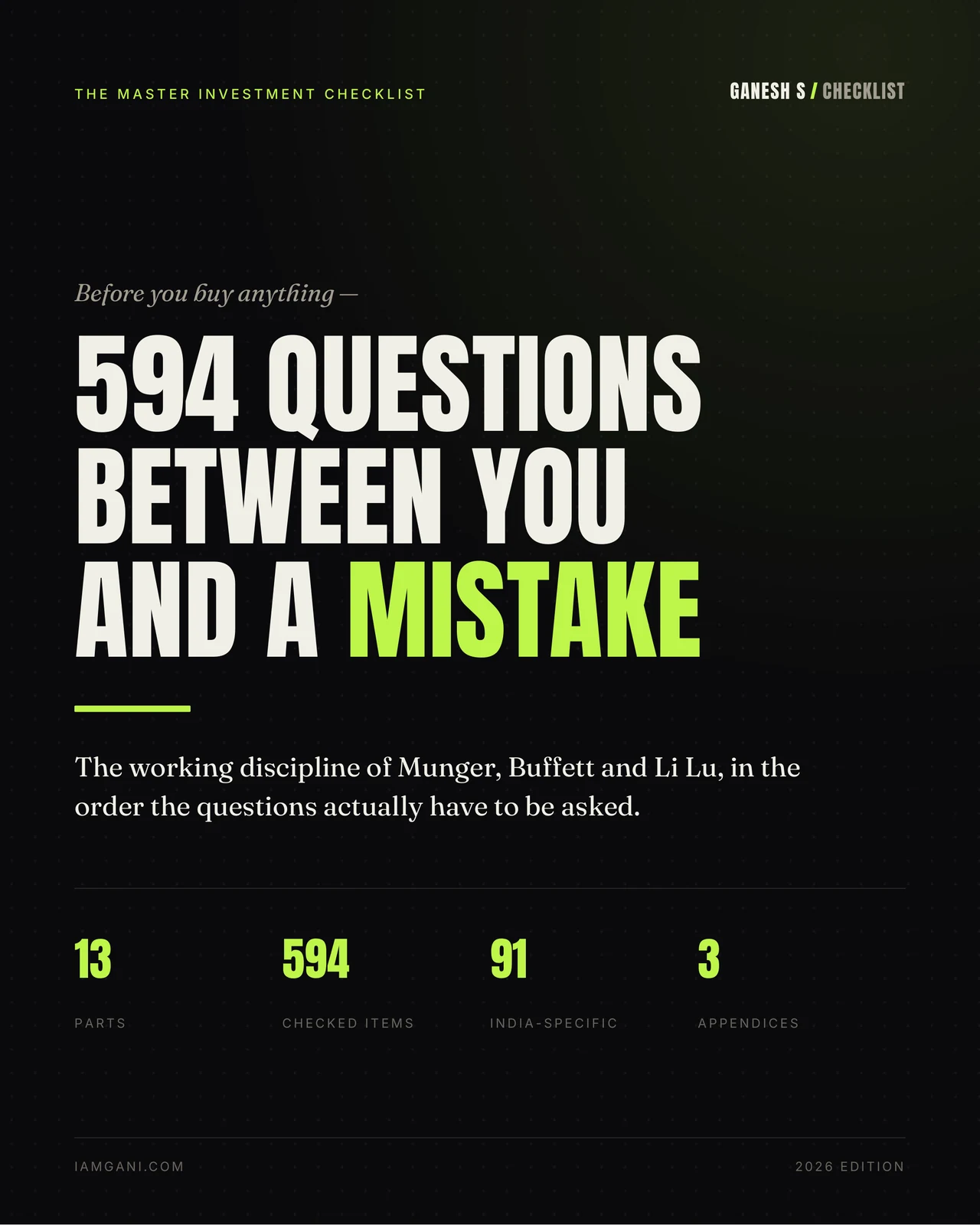
594 questions between you and a mistake.
Not a theory of investing. An attempt to hold, in one place and in the order the questions actually have to be asked, the working discipline of Munger, Buffett and Li Lu — assembled from their own words rather than from commentary about them.
The difference that matters —
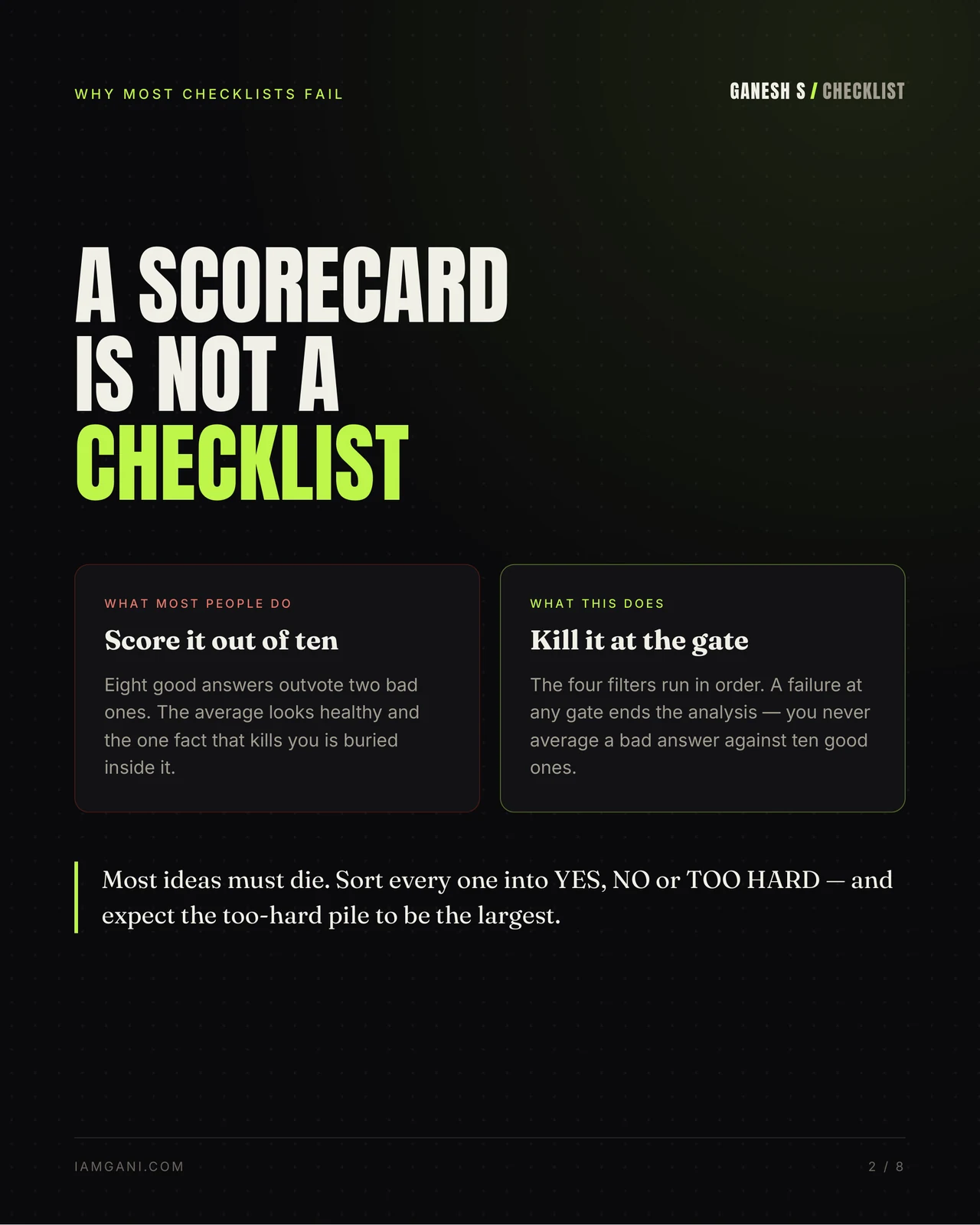
A checklist, not a scorecard.
A scorecard lets a good answer cancel out a bad one. Ten strong marks and one fatal flaw average out to "quite attractive", and you buy it. That is how most people talk themselves into the position that eventually costs them.
This runs as sequential kill-switches instead. Munger's four filters, in order — and a failure at any gate ends the analysis. You never average a bad answer against ten good ones, because you never get to the ten.
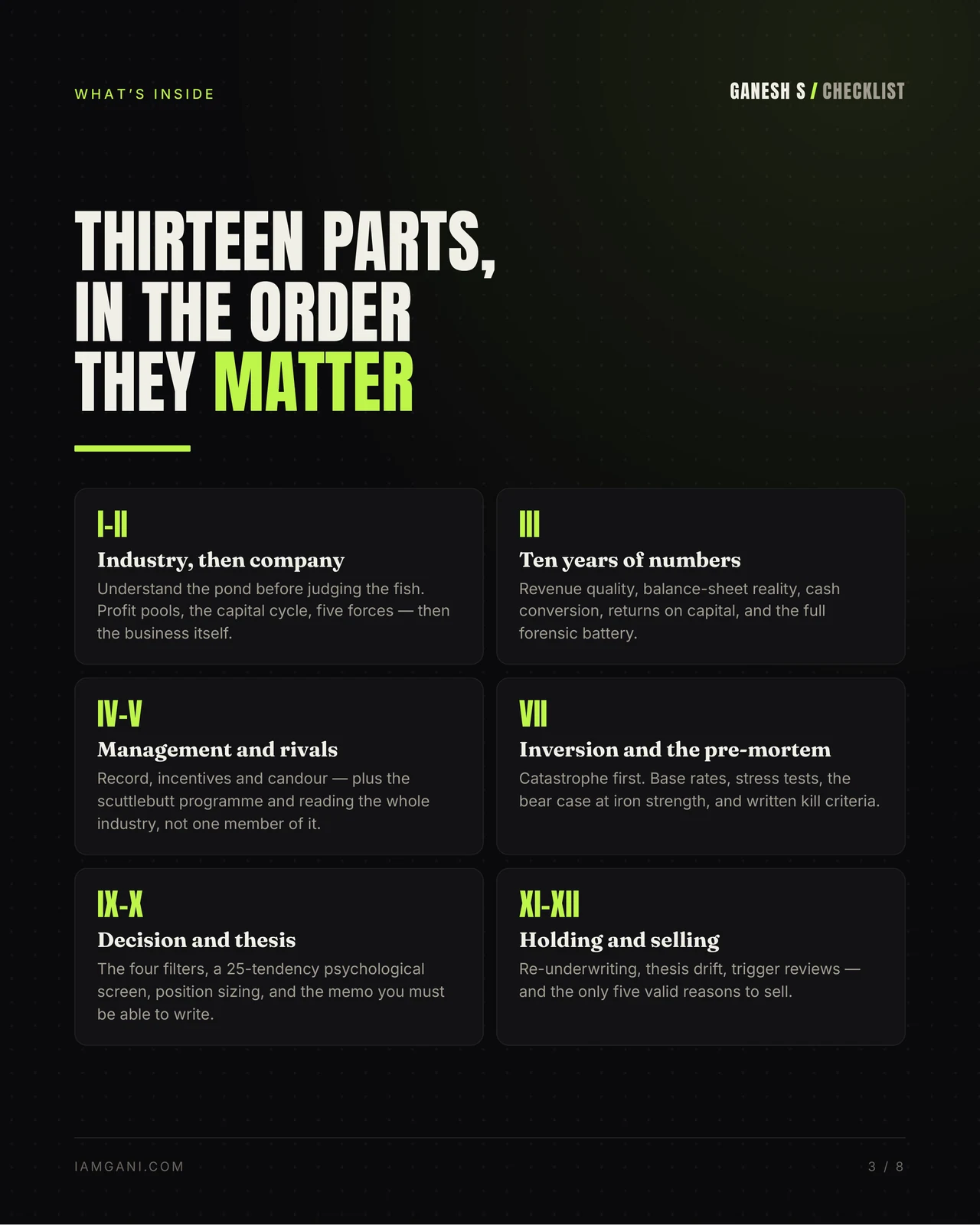
Thirteen parts, in order
Structure
The gate
Interest and honesty, circle of competence and its boundary, why this opportunity exists at all, a bias scan on where the idea came from, and assembling the reading stack before you start forming views.
Industry, business, numbers
Thirty to fifty years of industry history, the profit pool and where it sits, the capital cycle, unit economics, pricing power and the moat — then revenue quality, balance-sheet reality, returns on capital, a capital-allocation audit and the full forensic battery.
People, rivals, technology, risk
Management, governance and ownership; the competitive set and a structured scuttlebutt program; technology clock speed, obsolescence and explicit kill criteria; then inversion and a written pre-mortem.
Price, decision, and after
Valuation, decision discipline and psychology, the written thesis, post-investment monitoring and selling discipline. Most checklists stop at "buy" — this one covers the whole holding life.
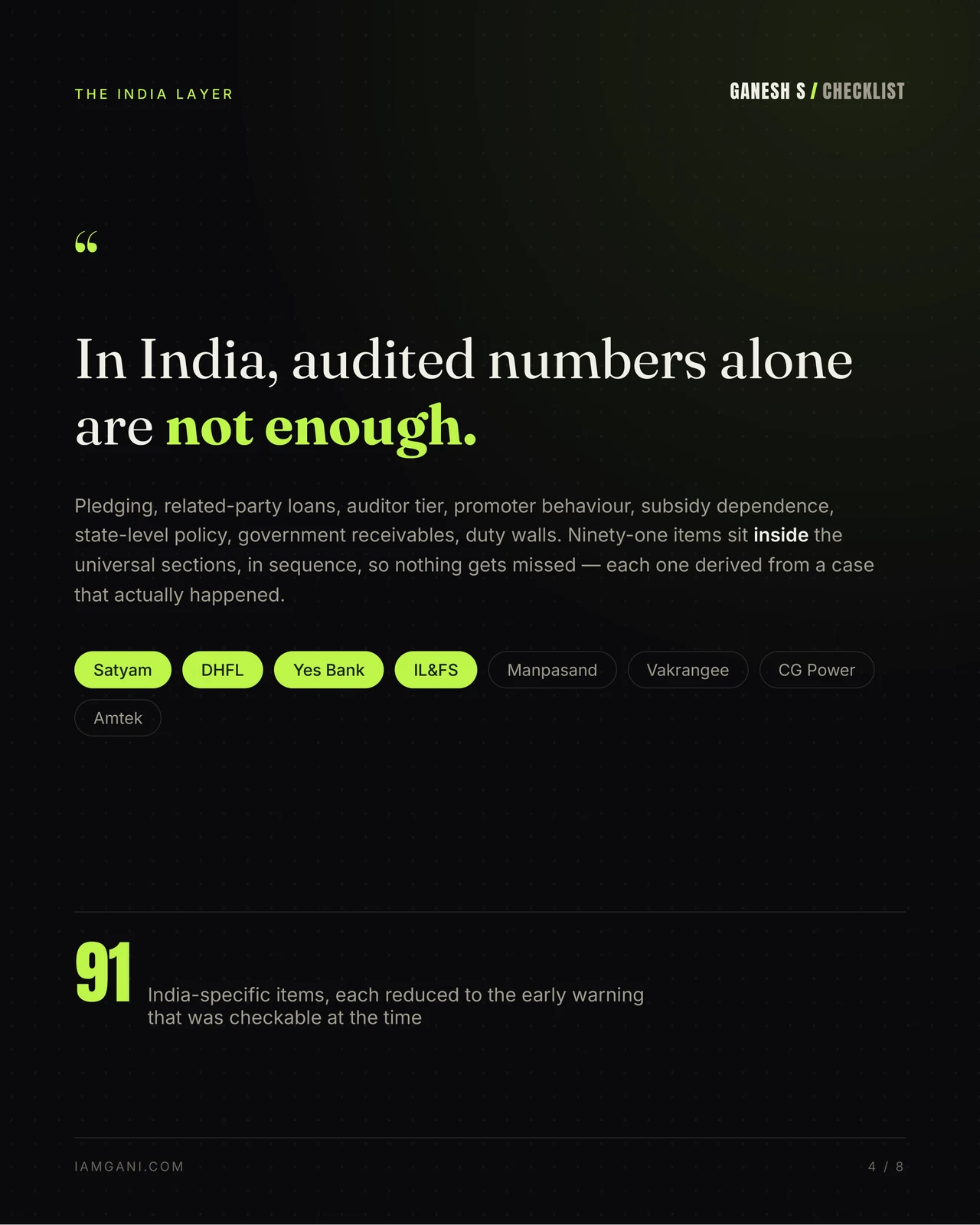
Plus three appendices: a rapid kill sequence for triaging an idea in minutes, a master red-flag registry, and the full source list. 91 items are flagged India-specific — regulation, the forensic battery, board norms, insider behaviour, scuttlebutt practice and the fragility count.
Where it comes from
Provenance
Primary school
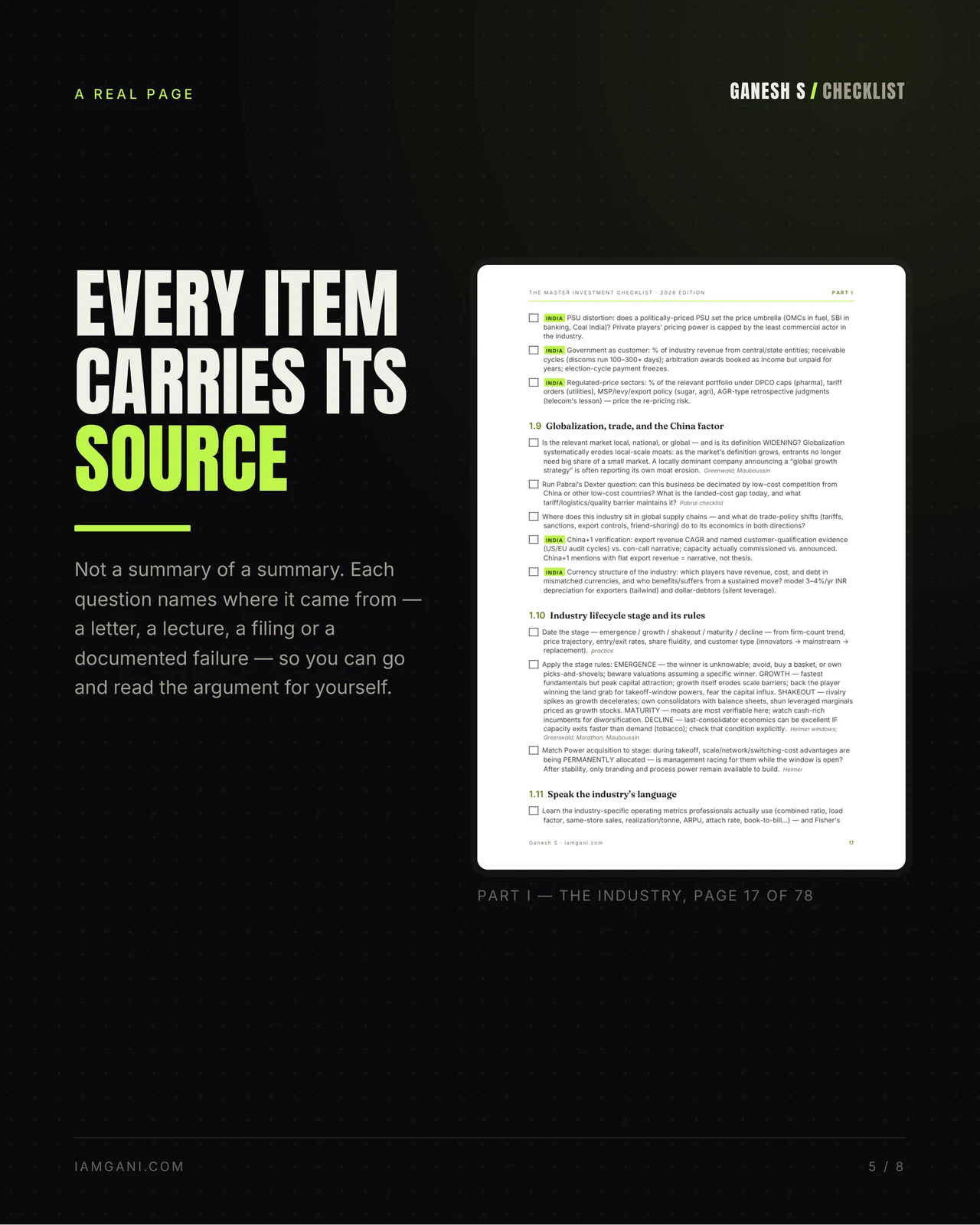
Buffett's partnership and Berkshire letters, the Owner's Manual and the acquisition criteria. Munger's four filters, inversion and the twenty-five standard causes of human misjudgment. Li Lu's Columbia and Peking lectures — the accurate-and-complete standard, and the doctrine that an ability without a boundary is not an ability.
Practitioners and frameworks
Pabrai, Spier, Fisher, Graham, Lynch, Klarman, Sleep, Akre, Terry Smith and Shearn on process; Dorsey, Helmer, Greenwald, Mauboussin, Porter, Marathon, Christensen and Gadiesh & Gilbert on the structure of competitive advantage.
Forensics and the India layer
Schilit's shenanigan taxonomy with Sloan, Beneish, Piotroski and Altman; Thorndike on capital allocation; Marks on risk; Klein, Kahneman and Duke on pre-mortems and kill criteria. The India layer draws on Bakshi, Mukherjea/Marcellus, Ambit and others.
Built for rejection first
Sort every idea YES, NO or TOO HARD — and expect too-hard to be the biggest pile. Pabrai rejects most companies in under a minute, and Appendix A's rapid kill sequence exists so you can do the same before committing weeks to the deep parts.
The full checklist is a final gate, not a research plan. Do the work first; run the 594 items immediately before the decision, when you have something real to test.
Two options
Pricing
The checklist pack
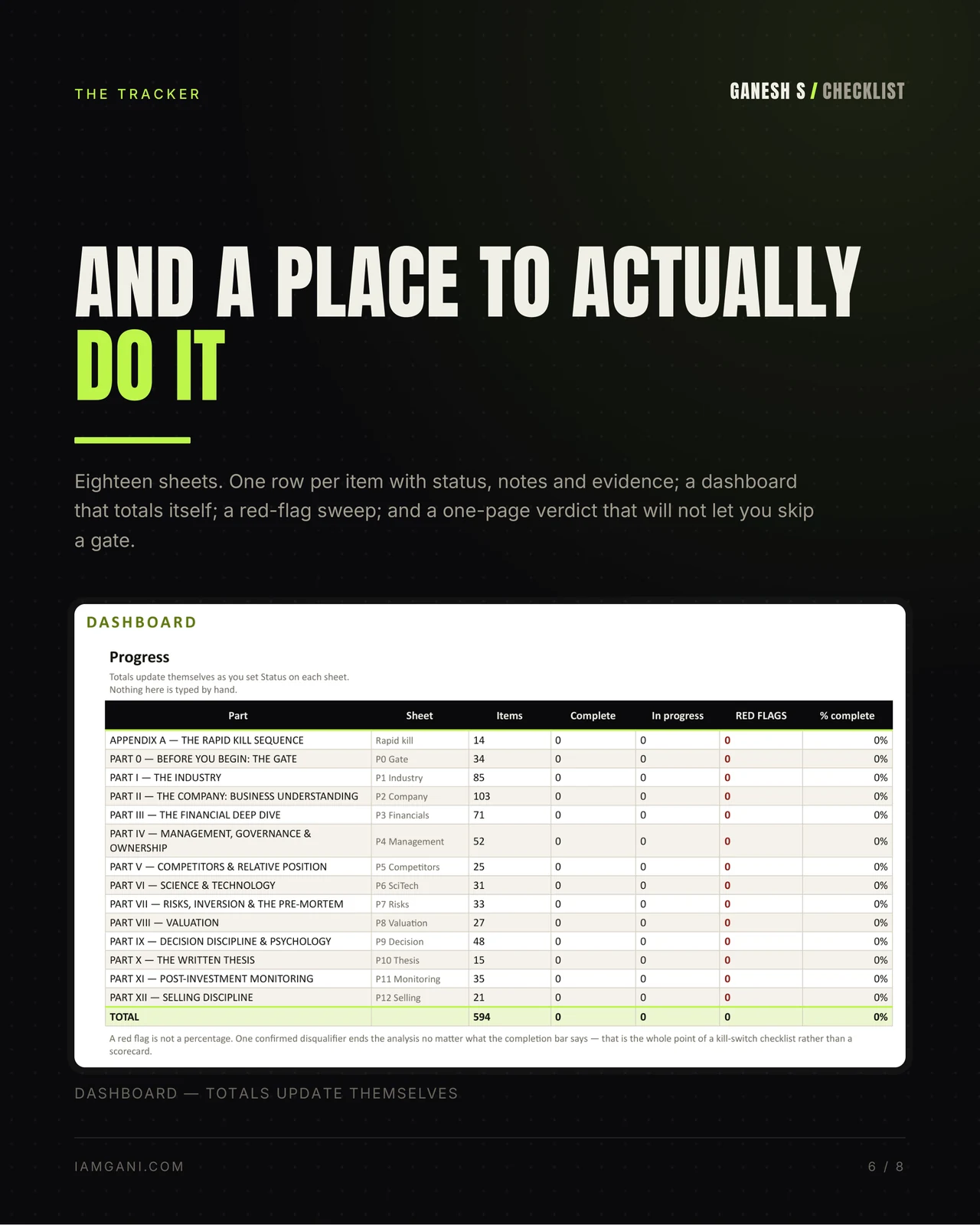
Checklist + Tracker
- 594 items across 13 parts — 78 pages, PDF
- The same document as an editable DOCX
- The 18-sheet Excel tracker for working through it
- Three appendices: rapid kill sequence, red-flag registry, sources
- No AI source-collection skill
Best value
Checklist + AI Skill
- Everything in the checklist pack, plus…
- The Study Material Collector — an AI skill that hunts down the sources needed to answer the 594 items
- Maps every item to the source types that can answer it
- Outputs a verified research library, plus an honest list of what it could not find
- A written how-to guide, for non-developers
Download link shown here and emailed to you — you can't lose it.
About the AI skill
Included at ₹299
The checklist tells you which questions to ask. The bottleneck is finding the documents that answer them — annual reports going back decades, prospectuses, concall transcripts, credit-rating rationales, regulator orders, patent filings, court records and trade data, scattered across a dozen Indian portals that each misbehave in their own way.
The Study Material Collector is built to do exactly that hunt, and nothing else. Name an Indian listed company and it works through the checklist's own spine — industry, then business, competition, technology, risk — collecting and verifying sources into an organised research library. It is built to save you the fifty-plus hours of searching, downloading and filing that otherwise sit between you and a first honest opinion.
A collector, never an analyst
It finds, verifies and files sources. It does not summarise, rate or conclude — deliberately. The judgement stays yours, which is the only way a checklist is worth anything.
Honest about gaps
It never claims coverage it does not have. Where a document could not be found, it says so and logs what it tried — a NOT-FOUND is treated as a legitimate result, not a failure to paper over.
Works with any capable AI
Written for Claude Code, where it installs as a skill folder, but the instructions are plain text and work pasted into any capable assistant. The included how-to guide walks through a full worked example.